






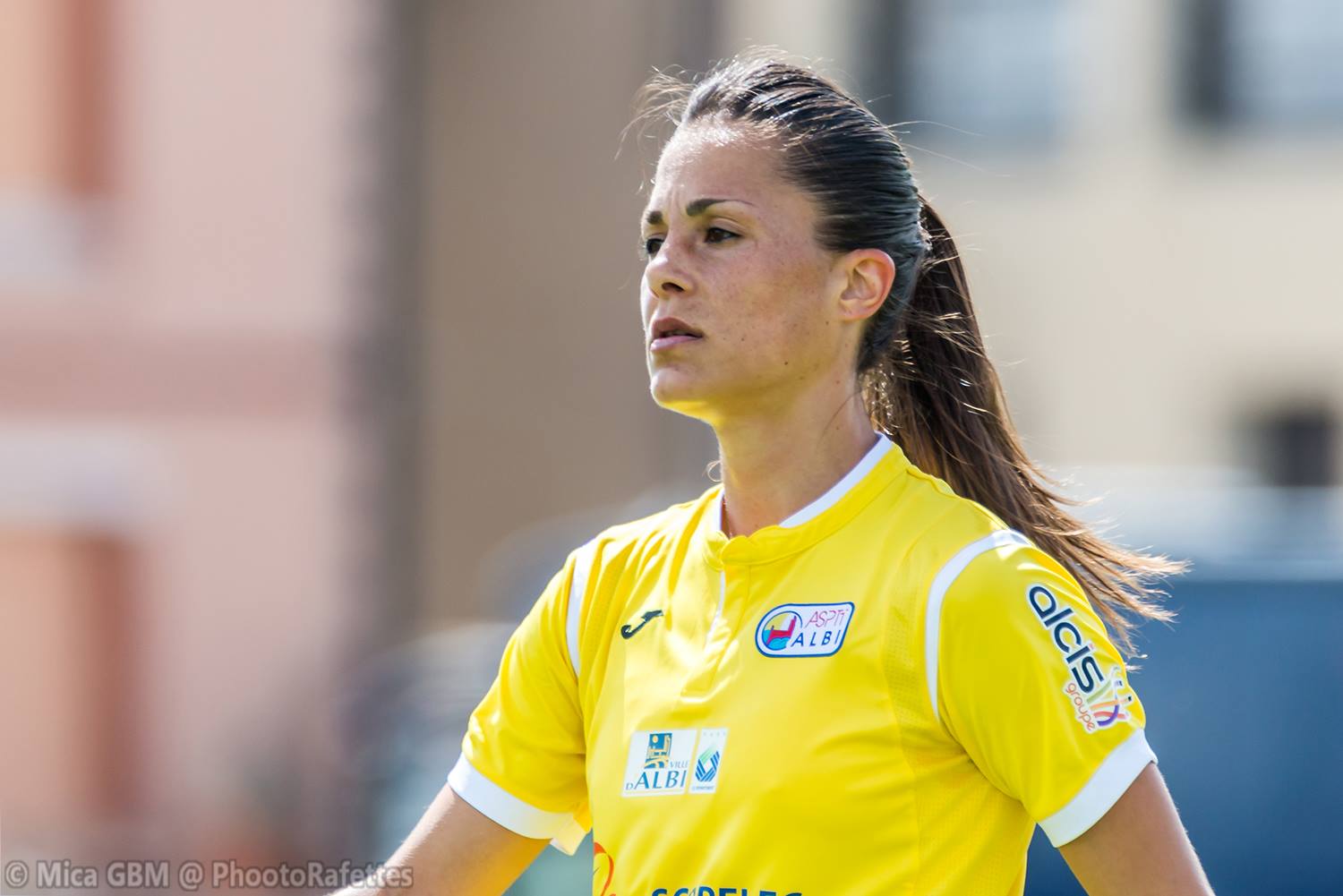
Former player of the Barca and former Spanish International U19, Patricia Martinez Augusto has been playing at ASPTT Albi for three and a half seasons today. Interview with a player who managed to rebound after a serious injury, but who had to make a cross on his dream of the national team of Spain. She goes back on her course, the Spanish football and her game in the field.
Football Hearts - I saw that you come from Ponferrada (his first club is Fuentesnuevas) in Spain, it's just above Portugal? There's a little statistic that intrigued me. I saw that there were about 70,000 inhabitants in your city of origin, and about 50,000 in Albi. I take it that you like small towns? So if you were offered to play in Marseille (850000 inhabitants), Lille (227000 inhabitants) or Paris (2.2 million inhabitants) you would not have accepted?
P.M.A. - Ponffeeerrada (she repeats the name of her city with the Spanish accent ndlr). Yes it is in the North of Portugal. It's a lot like [Albi], it's the first thing I noticed when I came here. I feel a little like home, it's almost the same atmosphere. I like "small towns".
(thinks) After all this is not the reason, but if I have to choose I prefer to live in a small village or a small town, that's for sure. That's not exactly why I came here. I was lucky that Albi is looking for an attacker, when Stephanie Roche left [in Houston].
Football Hearts - I read in an interview that you gave Marca, that you started "football by chance" at 4 years old *?
P.M.A. - Yes, in fact I had to stay there during the training, because my mother had to accompany my brother and wait for him. Sometimes I went there and my brother was not there.
Football Hearts - I also read that you had been club captain and U19 selection, it feels like when you see on the field, you are calm and at the same time energetic. You want to give the best and show the example to your teammates we feel.
P. M. A. - Yes and no, it depends because I am calm about the way I speak. I'm not going to warm up the team before a game, but if you have to put your foot between two players I'll do it.
(moment of reflection) Yes, I am a team player. I do not calculate my efforts and I will not hold back, even if I have to run more than some of my teammates.
Soccer Hearts - Are you starting your fourth season now with Albi and there have been a lot of changes? How was the adaptation with the new coach and the integration of the new players?
P. M. A. - I arrived on January 15, 2015, so I did two seasons, a half season and I started my third season. Since I'm in Albi, it's almost always the same girls, there was a change of coach but the staff remained the same, he just got a little bigger and we have two coaches now.
Football Hearts - Did you tell Marca that you come to Albi to "live the football experience in depth" because at the time football in Spain was marginalized, poorly publicized? But today it has changed, with Veronica Boquete for example who is ambassador of La Liga?
P. M. A. - Yes and even today. It's strange because until this year, you play football but you do not have the right to be professional. Playing in Albi - while the club does not have many means - I have the right to have a contract that allows me to be recognized as a professional player. In Spain you do not have a fixed salary and if you get injured or if you want to retire as a footballer, you do not have unemployment. This season has changed but not for all clubs, there are only three or four clubs, some players do not have this privilege.
Yes there are players like Boquete who fought for the Spanish football to change, because she had the chance to play in several championships (Germany, Sweden, USA, France) and that allowed her to see what's in Europe. When you come back to Spain it changes your vision. The Spanish team is not that bad, the media presence is increasing but it does not change the status of the players.
Football Hearts - Today it's anecdotal but when you left Sporting Huelva, the same season your ex-teammates were able to take part in the Copa de la Reina and they won. You said when joining the club that was the basic goal for you. You regretted not to live this experience? You congratulated your former teammates at the time?
P. M. A. - Yes it was a shame, because having a title in your list is always better. But I made a choice and I left in a good time for me, so I do not regret anything. After that it sure would have pleased me to have it. My last match was against Atlético de Madrid and they finished champion of the season last year. Yes (smile) I congratulated many.Football Hearts - So last season I saw you play and I remember very well that you played on the sides (right / left). I'm not wrong ?
P. M. A. - Yes, that's it. This is a post that I do not particularly like [playing on the sides]. When I started with the boys, I played liberals, after midfielder / axial and when I started with the girls, I was attacking. When I arrived in Albi, I was asked to play on the sides. It was difficult to adapt at first, because I did not know this job. After if I have to play this post I will give the best of myself. But I do not think the best player I can be is at this post.
Football Hearts - Yet I know you're a technical player, so maybe that's why you're playing on the sides? Sometimes you went a little in the axis and more so it's your habits that come back at a gallop? This is what characterizes you?
P. M. A. - On the sides I feel a little limited, because it's a position where I'm not comfortable even if I'm "technical", and speed is not one of my qualities either. For me a player on the corridors, either she is very technical or she runs a lot and it is not my greatest strength at home, so it limits me a little [to play on the sides]. By cons, I can play with both feet and with the head I'm not bad, that's why a more axial position better match me.
"You must be more technical and less physical."
Soccer Hearts - Is this something that is really peculiar to the Spanish to be technical can we say?
P. M. A. - Yes it is true that in Spain it is a little different, because here it is much more physical and the referees leave more contacts. Unlike the Spanish league, where each physical action is going to be whistled so you must be more technical and less physical.
Football Hearts - I've also noticed that you've been changing your vision of the game a lot, looking at your feet, the ball, and around you to find the solutions.
P. M. A. - (...) Yes, yes, yes. It may be because I was an axial player. When you play in the middle, the players can come from all sides, so before receiving the ball you have to know where you will send it and know the girls with whom you play. Sometimes I do not watch, I know my teammate's moves and how they play, so I know she's going to ask for the ball in a certain way and it would be odd if she did not ask me that way. It's a technique to play faster [automatisms].
Soccer Hearts - Do you think of yourself more as an attacker or a midfielder? Or we can also say a fake 9?
P. M. A. - (hesitates) We will say that compared to my age today (she is 27 years old) it depends on the team we play. If it's a very technical team I think rather attacking because it's very rare that I miss a face to face, but I would be rather middle if you have a fast forward in the team, to make it the last pass.
Yes that's right, I'm more of a fake 9.
Soccer Hearts - You also try to be physical but we still feel that it's not too much in your Spanish DNA, it's probably the fair play of not going too much into contact? Because to stand up to players who play in Paris or Lyon, you have to be physical?
P. M. A. - Yes after that depends on the regions [in Spain]. The Basques are famous for being physical and going to the contact and at home in Ponferrada, we are also a little like that. So it's a bit normal to fight, even if it's not everywhere in Spain. I knew that and playing with boys, it reinforces a little more. But I think it has to be a mix of both [technical and physical].
Yes exactly, but we must think about what we do, whether it is at the physical level or at the technical level.
Soccer Hearts - I saw on your Twitter account that you shared an article about physical fitness that is non-existent in Spain. That is, the players are not physically prepared?
He (Paco Seirulo) also talks about other things, but it depends on the country. Some think that preparation is running and suffering, they do not adapt to the sport they coach. In this article, it evokes preparation among footballers. He says that the footballer who is muscle and runs hard, is not necessarily better or better prepared than the one who prepares with the ball and tries to do his training in relation to his position. I share that idea a little bit.
"These are sacrifices but when you like it you do not see it that way, because you like to play."
Football Hearts - The Sporting Huelva geographically I saw that it is very far from your home region, so you always had to move far to play in "women's clubs" we will say?
P. M. A. - Yes, because in order to play in the club of my city, they had to change the law already. Until now, girls could not play football. Today we can play freely, in France everything is normal but in Spain it was impossible. I stayed four years in this club, I did the training but I could not play the matches. After they modified the law so that the girls could play with the boys, but that until 14 years, passed this cape there was no female team [in my city]. There were some in Barcelona, or Madrid because they are more developed cities.
So if you wanted to play more than just your friends where we could do a match three, (laughs) it had to move. That's why at 15 I left home. These are sacrifices but when you like it you do not see it that way, because you like to play. Maybe today - because I'm almost at the end of my career - seeing by all that I do and seeing the chance that girls have today to be able to play and that they do not do not take advantage ... While me with all the efforts I made when I was young, I could not have half of what they have now. That's why the more experienced girls who have gone through many difficult stages and times are fighting a little more on the pitch. What I have today in Albi, if I was 18 years old, I will have an incredible career (editor's note).
Hearts of Soccer - To bounce on youth, I know you played in the youth categories in U19 (it starts at 16) and that if I do not make mistakes, you're still the best scorer U19 Spanish (24 goals in 19 matches)? What do you remember from this experience?
P. M. A. - Yes (white). It's weird but it's like that. When I started playing with the U19, I was 16 years old because there was only that and the seniors. There was no lower category ... There were only two national women's sections. So I played there from the age of 16 until I was 19 years old. I was in the best period of my career (we feel emotion when she talks about it). I never missed a face to face against the goalkeeper, it was sure it was at the bottom. Except that after that, I got hurt and I fell to the bottom and it was harder ...
Football Hearts - (moment of silence) I know it was an injury that was difficult to overcome, but were you in Barcelona or in selection at that time?
P. M. A. - I was playing in Oviedo at that time and I was in selection, it was a classification match against Switzerland in Italy. I remember it today when I see Ramona Bachmann playing Rosengard I think (Chelsea since this year actually), so I played against her this game and we won. I followed her path and now that I see where she is and where I could arrive too ... It's bad luck. I took it personally because we were playing Spain against Switzerland. Me as a Spanish leader because I had scored and she as a Swiss leader and that day we won ...
It was at this moment that I felt that the back was wrong. When I returned to Oviedo, we had to do the preparation with the team, since it was during the summer that we participated in the tournament, but I could not and this second season with Oviedo, I I went on the bench because of this injury.
Hearts of Foot - You still won during your two years in U19 Copa Atlantico where you will be the best scorer and best player in addition. These kind of moments are still engraved in your memory?
PMA - Yes, but all the moments that I spent with the Spanish team are huge, because I was in the best moments of my career and it was different because at the moment the Spanish football, there was not as much level as today. To be able to play good football, all girls had to be good. Today you can have a sidebar that is a little weaker or the middle, but you have to deal with it to compose a team.
"I went from the top to start from scratch."
Soccer Hearts - Could not you hope to go higher in the national team because of this injury eventually despite all the sacrifices you had to make at the time?
P. M. A. (moment of reflection) I think so. After you never know, because I could play until 20 years or 22 years and stop at that age football. I think the injury was the one that ruined my career because I went from top to bottom. For six months I could not do anything, I could not even walk, I was ... (shortness of breath with the mouth). It is very hard to return to the field after that, we are afraid to go into contact, for fear that it will come back. I did not know when it was going to heal. It took me two years to get back on the field, but I did not have my level.
Football hearts - This summer after a rebounding evening, Spain U19 has won its second title since 2004, after three lost finals in a row (five in total for seven played). It was still tedious for young people, you who knew this category well?
P. M. A. - Yes, but the players have incredible potential. The problem is that the best players are not always called in selection and that I do not understand. The girls who play in the rankings clubs are too slow to have the international level, because these players have to juggle football and studies sometimes work and as I said in Spain you can not do both. Workouts are too demanding and at some point you have to make a choice. Either you take the risk and you succeed, or you fail and you find yourself at 30 without anything.
Soccer Hearts - It can slow down the growth of good players. Because I was in the last match of Spain against the French team (lost 3-1) and I felt that the Spaniards were limited either individually or collectively. How come ?
P. M. A. - Yes, but I think it is limited in relation to that. Because you see that Lyon girls can live with Football and girls in Spain do not even win half I think. So already compared to that you have to organize your life next to live. And when you play with the national team, it's not a huge salary either."This injury at the time I was young it allowed me to open my eyes to predict my future by forming me next."
Soccer Hearts - I think you played with Marta Torrejon and Jenni Hermoso among others in youth section with the Spanish U19 team. Do you know if they on their side they manage to have the morale to play in selection precisely?
P. M. A. - Yes, I have no more contact with Jenni, but I saw Marta again during the tournament we organized in Albi this summer. They live only football I think, they do not think about if it does not work how they will do. I had "bad luck", but this injury at the time I was young, it allowed me to open my eyes to predict my future by forming me next.
Football Hearts - To talk about this, I think you are in chemistry (control and quality analysis in analytical chemistry)? I saw that you had been chosen even by the D1 to represent the Albi club and in this video you mention double project elsewhere?
P.M.A. - Yes, I have a BTS in chemistry and now I am in license pro "engineering chemistry and process engineering" in France. It is more important to have a French diploma, than Spanish today.
I have to get up every day at 5.30am to be in Toulouse at 6.30am, because classes start at 8am and I finish at 5.30pm. Then I follow the physio from 18h to 20h since currently I am injured, otherwise it's training and I do not arrive before 21h at home. These are very long days. In addition, there is the language barrier and in Spain it does not work like studies. These are my choices, nothing is easy, but if tomorrow I stop the football and I must continue to have a job, you have to make these sacrifices there.
Soccer Hearts - As you said in an interview "We play with the illusion of being pro." ** So the passion of football is stronger than anything?
P. M. A. - Yes it is true that when you come to play in a team like in Albi, in your head it is not to make money. Albi plays with girls who are near the club, or young people who want to know the high level and train. But it will be difficult to see international players. At PSG for example I could not have my dual project, especially at my current age.
Soccer Hearts - Yet you are not your age and you have the level.
P. M. A. - (laughs) Yes, there are many people who tell me that. But I have a fairly strict lifestyle.
Soccer Hearts - I know you started on February 1st (17th day) with Albi and against PSG and more. It must be remembered that you arrive mid-season on January 15 in Albi, having made a test in December.
P. M. A. - Yes, it was a bit of a coincidence (because a player was out on injury in the 6th minute).
Football Hearts - You told me that you only played one match against Montpellier, before you hurt yourself. How did it happen to you?
P. M. A. - I had a tear in my leg during the preparation, except that we did not know it. I was in pain but not more than that. And the pain was variable, there were times when it was very painful so I rested for two / three days and I resumed, but with races only. As soon as I started again with ball, I was very very bad and after the first game of the season against Montpellier (lost 7-0) I echoed and we saw a tear of 3cm behind the leg. Every time I started again, I tore it a little more. I needed 6 weeks to treat him and there I have two left normally. I did not think I had it, I was in pain but I clenched my teeth, except that after that it was gone (nervous laughter).
* "My brother was training in a club, the CD Fuentesnuevas and I had to wait for him sitting on a bench every time, one day I asked the coach if I could play with them and he accepted. that's how I started football "
** "We do not have contracts as footballers (smiles, respond to my irony) .We play with illusion, we live with the minimum, and we work to play." But we hit long and heavy trips, where you end up playing life, because there are a lot of kilometers that you do.With what is today, in Spain, the girl who plays football does not do it for money but for the vocation. "
Photo: Mica GB M PhootoRafettes
![[UWCL, 1 / 8th finals return] Chelsea puts out Fiorentina, Bayern and Wolfsburg at the rendezvous](/backEnd/images/article/bf6078d9cad58f3ec76f1c6d1562c8df.jpeg)
![[UWCL, 1 / 8e back] OL - Ajax (9-0): Lyon qualify for 1/4 after outclassing Ajax](/backEnd/images/article/d30f6b37cf9200d87c3668b1de114da5.jpeg)

![[UWCL, 1 / 8e back] PSG - Linkopings (3-2): PSG cash, but valid his ticket for 1/4](/backEnd/images/article/3ab0e3eae3ed85022a807d575d8e5711.jpeg)